
Always Be Curious #315: Freaky fast humanoid hands, memory's evolution, and saving Hubble
This week in ABC: A new humanoid hand is kinda stunning, memory chips and their makers are evolving rapidly, and the effort to save the Hubble telescope

Sup Curious Clan! ✌️ This week’s showstopper: 1X unveiled the new humanoid hand for its NEO robot, and it is a stunning piece of engineering.
WIRED got an early look and called the fingers “freaky fast”, but the speed is honestly the least interesting part. Each hand packs 25 degrees of freedom (the number of independent ways it can move): 22 fully actuated in the fingers and palm, plus 3 at the wrist. And those aren’t spread evenly; they’re distributed anatomically, deliberately biased toward a thumb that genuinely opposes the fingers, just like yours does.
The drivetrain is where it gets really clever.
Instead of stuffing motors into the fingers, the motors live in the forearm and pull tendons through the wrist, keeping the hand light and its inertia low while still producing high forces. Those tendons run at gear ratios of roughly 5:1 to 15:1, versus the 100:1 to 200:1 typical in robot hands. Why does that matter? Aggressive gearing makes a hand effectively numb: any feedback from touching something gets swallowed before it reaches the motor. At low ratios, every one of the 25 joints is backdrivable (push it and it yields) and doubles as a force sensor. The hand always knows its own pose and effort without looking, which roboticists call “closed-loop proprioception” and the rest of us call “being able to bring your index finger to the tip of your nose with your eyes closed.” 🦾
The details keep delivering. Tactile skin across the fingertips measures contact and shear, the sideways force that tells you a glass is starting to slip, so NEO can regrip in real time. The hands are IP68 waterproof and food-safe, meaning the robot can make you a peanut butter sandwich and then wash its own hands. 🧼 The compliance is structural, not software: low gearing, tendon drive, and low distal inertia mean a hammer blow or a slammed drawer safely backdrives the fingers instead of snapping them. Finger assemblies have been validated to millions of cycles, everything from motors to custom electronics to tendon systems is built in-house, hundreds of hands already exist, and 1X says it can produce 10,000 this year. Their tagline for it: “an API to the physical world.” Hand manipulation has long been considered the hardest hardware problem in humanoid robotics; this is the most convincing attempt yet at solving it at consumer scale. 🤖
Elsewhere this week: Apple signed a $30 billion-plus deal with Broadcom for US-made chips (its largest domestic manufacturing commitment ever), Meta’s custom AI chips hit production in September on the way to doubling its compute to 14 gigawatts, Samsung guided to a record quarterly operating profit (19x last year), and Taiwan’s Nanya posted 79.5% gross margins on revenue up 684% year on year. Oh, and Wikipedia turned 25 while fighting for its life against AI scrapers, Grokipedia, and political pressure. Long live the 1ntarwebz, long may they fight. 📚💰
Have a good week, stay safe and sound,

👨💻The round-up in sci-tech💡
🦾 The 1X NEO robot has freaky fast fingers (WIRED)
1X unveiled new hands for its NEO home humanoid, and they are a stunning piece of engineering: 25 degrees of freedom per hand, tendon-driven at gear ratios of roughly 5:1 to 15:1 (versus the typical 100:1 to 200:1), which makes every joint double as a force sensor. Add tactile skin that senses pressure and shear, IP68 waterproofing (NEO can wash its own hands), and finger assemblies validated to millions of cycles. 1X calls it “an API to the physical world” and says it can build 10,000 hands this year.
📚 Wikipedia is in the fight of its 25-year life (The New York Times) 🎁
As Wikipedia turns 25, the NYT reports on the threats converging on the open-knowledge model: AI scrapers pulling its content into chatbot answers (human page views are down roughly 8%), Elon Musk’s Grokipedia fork, and mounting political pressure. In its quarter-century history, the encyclopedia has never had to fight this hard.

🔦 FCC approves first Reflect Orbital satellite (SpaceNews)
The FCC approved a satellite to test the ability to reflect sunlight into nighttime regions, a project criticized by astronomers and environmentalists.
🚛 Self-powered trailers could help decarbonise freight (IEEE Spectrum)
IEEE Spectrum looks at electrified trailers with their own batteries and motors, which can be hitched to conventional trucks to cut fuel use and emissions without waiting for the entire tractor fleet to go electric.
🎮 Thousands of Pokémon Go players descend on Times Square to defeat Mewtwo (WIRED)
A decade after the Pokémon Go craze first swept the world, thousands of players flooded Times Square for a massive raid on Mewtwo, proof that the augmented-reality game still commands real-world crowds.
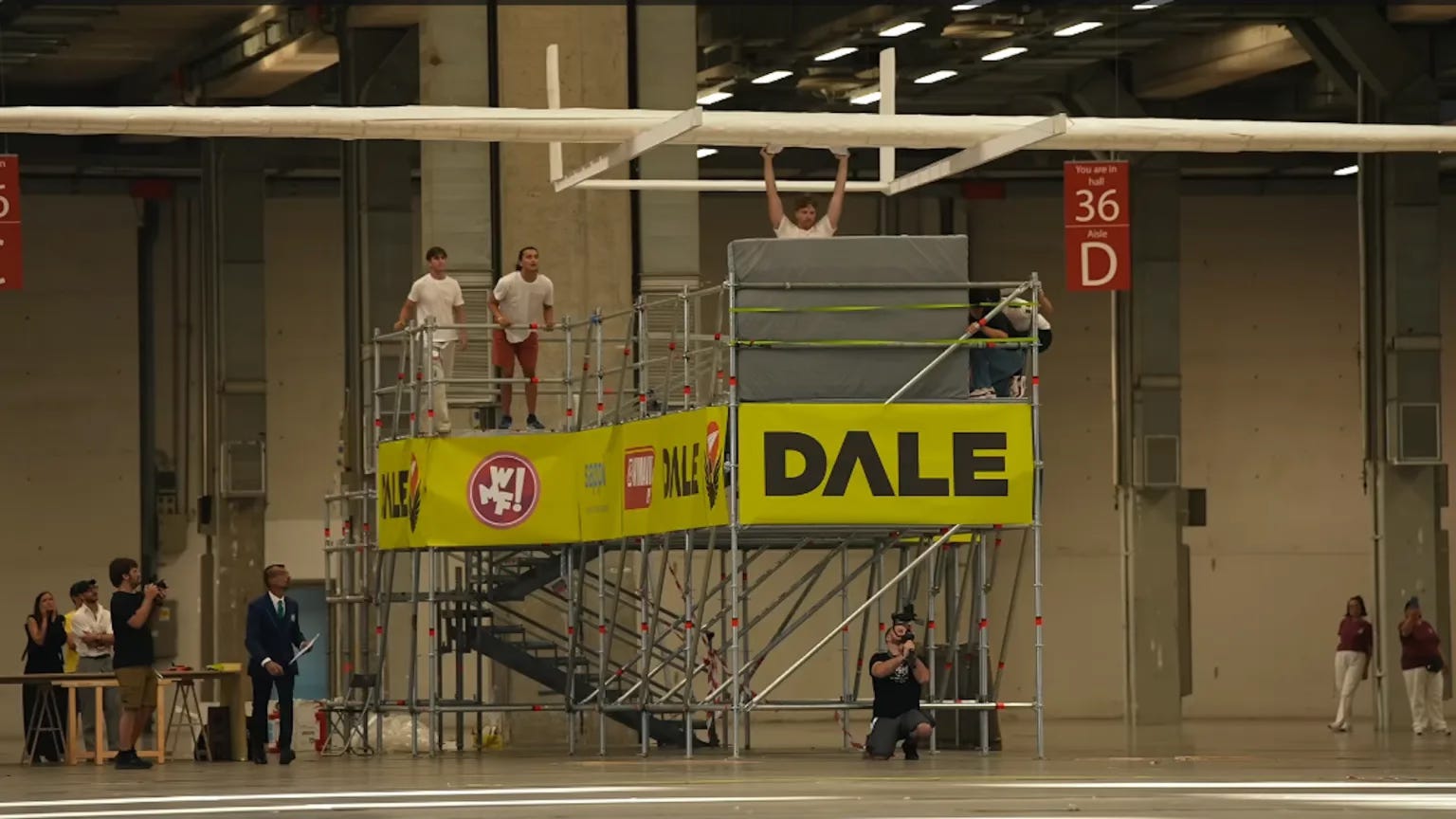
✈️ The world’s largest paper airplane (Popular Science)
Popular Science covers the engineering behind the world’s largest paper airplane, where aerodynamics, folding mechanics, and structural limits collide at a scale no classroom dart ever faced.
🔬 Book review: The rise of computer chips — and the race to control them (Nature)
An analysis sets out the history of computing beyond software and Californian entrepreneurs.
📺 China lands reusable rocket for first time, state media says (BBC)
China has successfully landed a reusable rocket for the first time in a major breakthrough for the country's space programme, according to state media.
🤓This week in chips⚠

🏗️ Micron accelerates US investments, pours first concrete in New York (Micron)
Micron poured the first concrete at its New York megafab, a milestone in its accelerating US expansion as the memory maker races to add capacity amid the structural shortage.
🧠 Intel patent reveals new XBM memory architecture that ditches HBM’s costly silicon interposer (Tom’s Hardware)
An Intel patent describes XBM, a memory architecture that drops HBM’s expensive silicon interposer in favour of a backend-transistor DRAM stack with UCIe links and built-in repair, a potential route around AI’s most stubborn bottleneck.
💰 Samsung’s profits jump 19x in a year, and you don’t need AI to figure out why (The Register)
The Register’s characteristically dry take on Samsung’s preliminary Q2 numbers: operating profit up roughly 19-fold year on year, powered by the AI memory boom and surging DRAM prices.
↔️ Stacking chips sideways (IEEE Spectrum)
IEEE Spectrum explores a lateral take on 3D integration: stacking chips sideways rather than vertically, a geometry that could ease the thermal and interconnect headaches of conventional die stacking.
🍎 Apple commits $30 billion to Broadcom for US chipmaking push (CNBC)
Apple signed a multiyear deal with Broadcom worth more than $30 billion, its largest US manufacturing commitment to date. The agreement covers more than 15 billion US-made chips and a $1.5 billion expansion of Broadcom’s Fort Collins facility for FBAR filters and wireless connectivity components, the biggest piece yet of Apple’s $600 billion American Manufacturing Program.
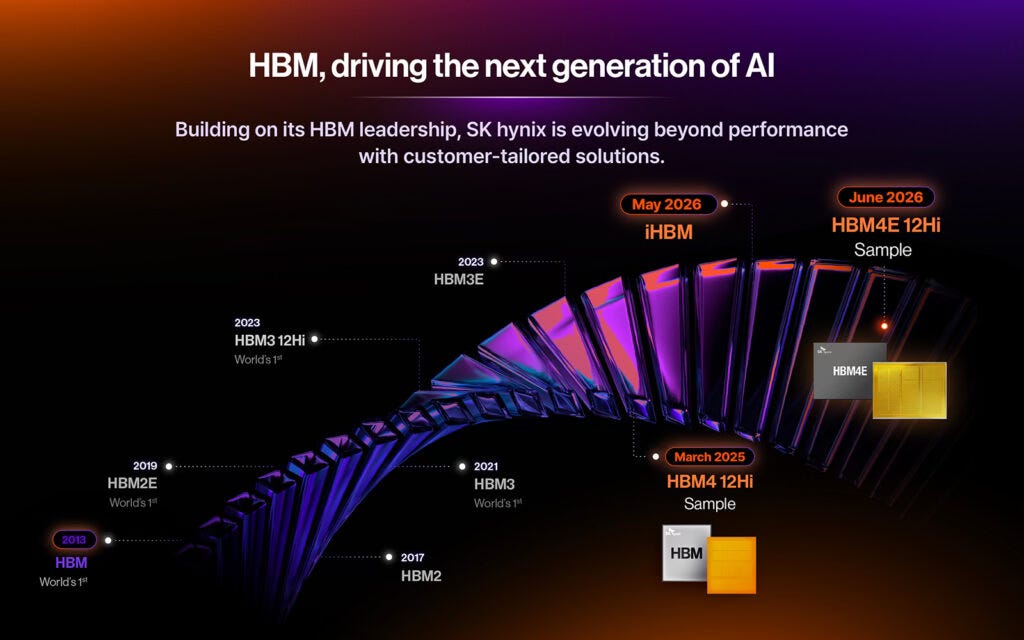
💾 From HBM to eSSD (SK hynix)
SK hynix explains how the AI boom is spreading from high-bandwidth memory into enterprise SSDs, as inference workloads and massive datasets pull storage demand up alongside DRAM.
📈 SK Hynix makes spectacular NASDAQ debut (The Chosun Daily)
Shares surge 13.08% as AI boom fuels investor optimism in memory semiconductor leader.
🤖 Meta’s new AI chips will begin production in September (TechCrunch)
Meta will put its custom AI chips into production in September, part of its plan to double computing capacity to 14 gigawatts next year. The company is taking a modular design approach, anticipating that its needs will keep shifting as AI evolves.
🏭 Reshoring chip industry risks failure with just more fabs (EE Times)
EE Times argues that building fabs alone will not bring the chip industry home: without the surrounding ecosystem of materials, packaging, tooling, and talent, reshoring efforts risk producing expensive buildings rather than resilient supply chains.
🎈 Intel CEO Lip-Bu Tan warned helium could choke AI chips in June, and China’s export ban might prove him right (WCCFtech)
Weeks after Intel’s CEO flagged helium supply as a hidden risk for chipmaking, China restricted helium exports, putting fresh strain on a gas that is essential for wafer cooling and EUV lithography environments.
📦 China breaks into panel-level packaging: CFMEE’s 510x515mm PLP system passes validation as country’s first (Trendforce)
China validated its first domestic panel-level packaging system, a 510x515mm platform from CFMEE, marking entry into one of advanced packaging’s most cost-sensitive frontiers.
📈By the numbers📉
📊 Samsung Electronics announces earnings guidance for Q2 2026 (Samsung)
Samsung guided to approximately $58.4 billion in operating profit for Q2, roughly 19 times last year’s figure and its third consecutive record quarter, driven by AI memory demand and soaring DRAM prices. Remarkably, the stock fell almost 7% anyway: a blockbuster quarter was already priced in.
📊 Nanya Technology Q2 2026 results (Nanya)
The Taiwanese DRAM maker posted one of the most dramatic turnarounds in recent memory history: net sales up 68.2% quarter on quarter and 684% year on year, with gross margin hitting 79.5%. The surge came almost entirely from pricing (average selling prices rose about 60% sequentially while shipments stayed flat), which management attributes to an AI-driven structural change in the memory market.
📈 Global semiconductor sales increase 9.2% month to month in May (SIA)
The Semiconductor Industry Association reports global chip sales rose 9.2% from April to May, an unusually steep monthly climb that underlines how hot the market is running.
❤️For the love of tech❤️

🔬 Save Hubble: the race to preserve the space telescope kicks off (Nature)
The orbiting observatory’s unique vision and public support continue to be crucial for understanding the Universe.
Always Be Curious is the personal newsletter of Sander Hofman, Communications Manager at ASML. Opinions expressed in the introduction of this curated newsletter are my own and do not necessarily reflect those of my employer.
I really like hand dynamics. But not more impressed with the 1X one than the Allonic hands.
https://allonic.co
The amount of strings and tendons give me deep appreciation for our human hands!